
PROMPT ENGINEERING - Dr. Sanjeevani Pandey & Dr. Pradip Kumar Sinha
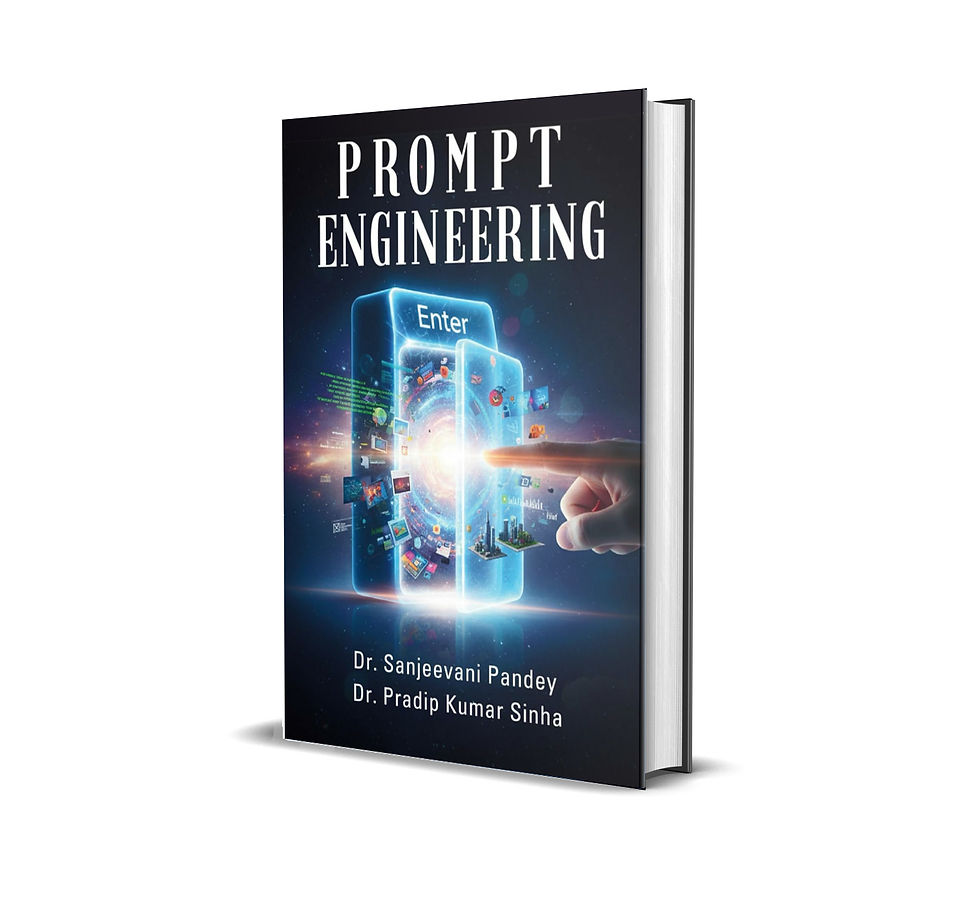
Prompt Engineering: Communicating with Intelligence in the Digital Age
The digital world is no longer evolving quietly in the background — it is actively reshaping how we work, market, communicate, and make decisions. Artificial intelligence now influences everything from customer engagement to strategic planning. Yet amid all this technological acceleration, one question becomes increasingly important: How do humans communicate effectively with AI systems?
Prompt Engineering addresses this very shift. It is not merely a technical discussion about AI tools, but a practical guide to understanding how human intent can be translated into meaningful machine responses. As AI becomes embedded in everyday workflows, the ability to craft clear, purposeful prompts is emerging as a critical professional skill.
Why Prompt Engineering Matters Now
In earlier phases of digital transformation, success depended on adopting new platforms and technologies. Today, success increasingly depends on interacting intelligently with them. AI systems are powerful, but their output is shaped by the instructions they receive.
This is where prompt engineering steps in. The book explains how prompts act as the interface between human thinking and machine interpretation. A vague request leads to vague results. A structured prompt produces precision, relevance, and depth.
By positioning prompt engineering as a communication discipline rather than a coding skill, the book makes the subject accessible to a wide audience — marketers, educators, business leaders, content creators, and curious beginners alike.
Understanding AI Beyond the Buzzwords
Artificial intelligence is often surrounded by hype, jargon, and unrealistic expectations. Prompt Engineering cuts through this noise by grounding AI concepts in clarity and practicality.
Readers are introduced to:
The fundamentals of how AI systems interpret prompts
The logic behind machine learning and pattern recognition
The difference between data, prediction, and decision support
How AI tools integrate into everyday professional environments
Rather than overwhelming the reader with mathematical complexity, the book emphasizes conceptual understanding. The focus remains on usability, enabling readers to see AI as a collaborative tool rather than an abstract technology.
Digital Transformation and Modern Strategy
AI does not operate in isolation; it is part of a broader digital ecosystem. The book explores how digital transformation is influencing business models, marketing strategies, and organizational decision-making.
Key discussions include:
The shift from intuition-driven to data-driven decisions
The growing importance of digital marketing analytics
Understanding customer behaviour through predictive models
Leveraging AI for efficiency, automation, and personalization
These insights help readers connect technological advancements with real business implications. AI becomes less about innovation for its own sake and more about strategic adaptability.
From Productivity to Creativity
One of the most compelling aspects of AI is its versatility. The book highlights how prompt engineering can enhance not only operational productivity but also creative thinking.
Readers learn how to use AI tools for:
Content creation and refinement
Marketing ideation and campaign structuring
Workflow automation
Research and summarization
Decision support and scenario analysis
By demonstrating practical applications, the book shows that AI is not here to replace human creativity, but to amplify it — provided the interaction is guided thoughtfully.
The Power of Data-Driven Insight
Modern digital environments generate enormous volumes of data. Yet raw data alone holds limited value without interpretation. The book explains how machine learning and deep learning models convert patterns into predictions — revealing trends in customer preferences, purchasing behaviour, and engagement dynamics.
This section helps readers appreciate:
How AI systems “learn” from data
Why predictions are probabilistic, not absolute
The role of analytics in marketing and strategy
The importance of responsible and ethical AI usage
Such understanding equips readers to engage with AI outputs critically rather than passively.
Crafting Effective Prompts
At its core, the book is a guide to mastering the art of asking. Prompt design is presented as a skill that combines clarity, structure, context, and intent.
Practical strategies cover:
Framing instructions for precision
Avoiding ambiguity and bias
Structuring prompts for different objectives
Iterating and refining AI responses
Aligning prompts with desired outcomes
This transforms prompt engineering into a transferable capability — applicable across industries and roles.
A Skill for the Future
As AI becomes increasingly integrated into professional and creative landscapes, those who can communicate effectively with intelligent systems will hold a distinct advantage. Prompt Engineering positions this ability not as a niche expertise, but as a foundational literacy for the digital era.
Whether someone is stepping into AI for the first time or seeking to deepen their practical fluency, the book offers a structured, approachable, and forward-looking guide.
Because in a world powered by intelligent systems, knowing what to ask may soon become just as important as knowing what to do.


